

How Do Template And Nontemplate Strands Differ
Main Difference – Template vs Coding Strand
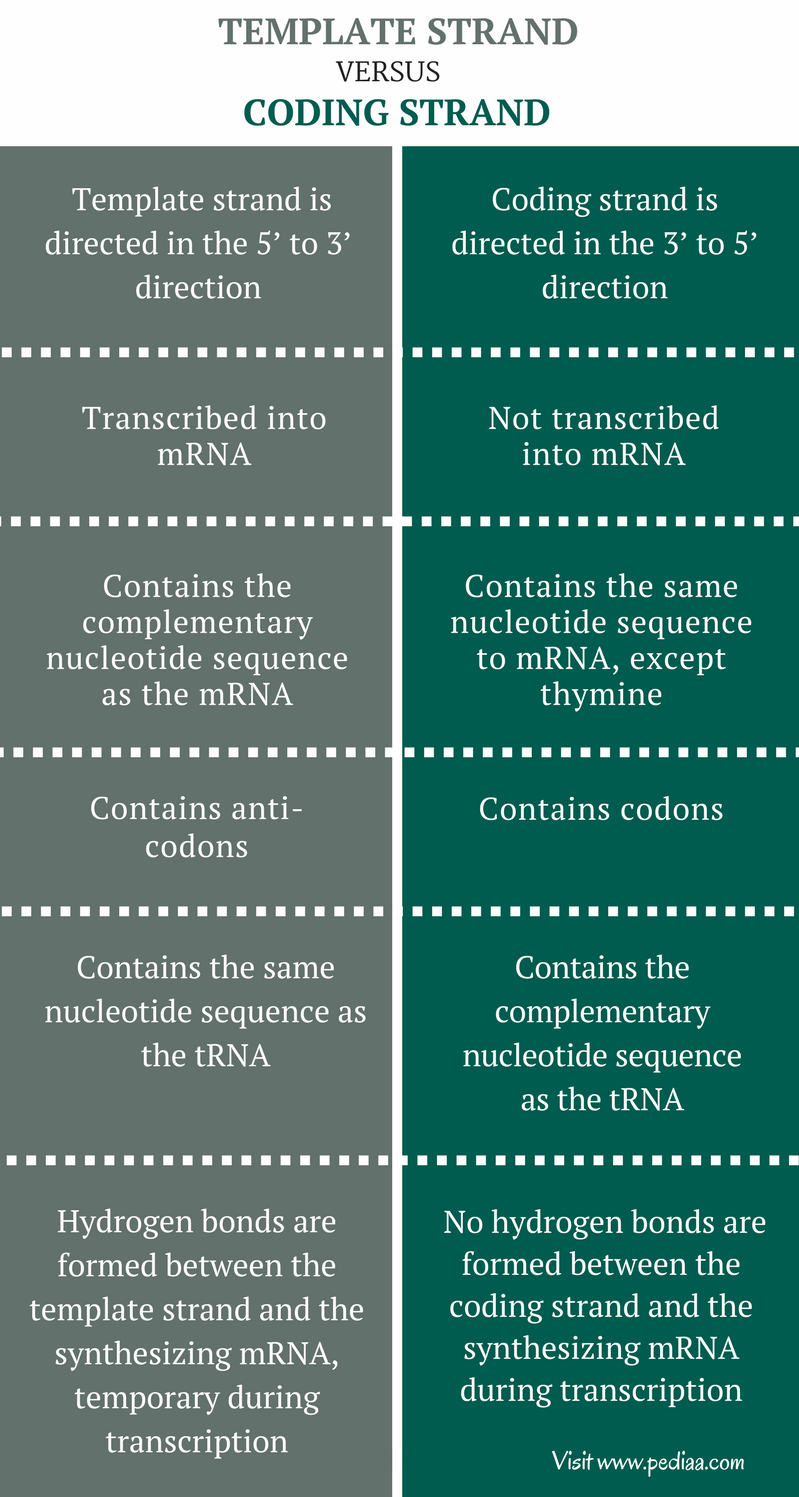
Template and coding strand are the two terms that describe the two strands in the double-stranded Deoxyribonucleic acid. During transcription, 1 of the two strands in the double-stranded DNA serves every bit the template strand. The template strand runs in 3' to 5' direction. The other strand in double-stranded Deoxyribonucleic acid, which runs from five' to 3' direction is known as the coding strand. The template strand is responsible for the amino acid sequence in synthesizing the polypeptide concatenation. The main departure between template and coding strand is that template strand merely serves as the template for transcription whereas coding strand contains the exact aforementioned sequence of nucleotides in the mRNA except thymine.
This article looks at,
1. What is Template Strand
– Definition, Characteristics, Structure
two. What is Coding Strand
– Definition, Characteristics, Structure
three. What is the difference between Template and Coding Strand
What is Template Strand
The template strand is the strand which serves as the template for the mRNA synthesis during transcription. Normally, RNA polymerase, which is the enzyme involved in the transcription of genes into mRNAs, adds nucleotides in the 5' to 3' management to the growing strand of mRNA. Therefore, the template strand should exist directed from iii' to 5' in order to add complementary nucleotides to the growing mRNA strand in the 5' to 3' direction. Hence, the DNA strand, which consists of three' to 5' directionality in the double-stranded Deoxyribonucleic acid, may serve as the template strand in transcription. That ways, the template strand is the Dna strand in the double-stranded Dna which is responsible for the amino acid sequence of the synthesized polynucleotide concatenation. The other Deoxyribonucleic acid strand in the double-stranded Deoxyribonucleic acid is called non-template. The template strand is too chosen the antisense strand or the positive strand.
The template strand consists of a sequence of anti-codons which are the nucleotide triplets found in the tRNAs individually. The anti-codon is complementary to codons in the not-template or the coding strand. The synthesizing mRNA is temporally attached to the template strand by forming hydrogen bonds with the complementary nucleotides in the template strand. RNA polymerase adds uracil as the complementary nucleotide to the mRNA strand for adenine in the template strand instead of thymine. The template strand in the transcription is shown in figure 1.
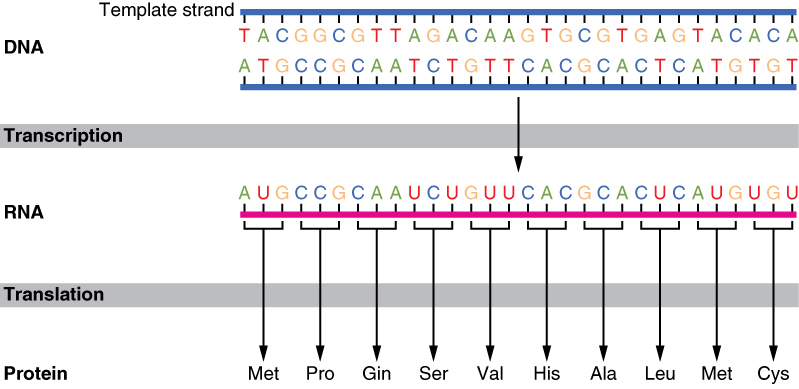
Figure ane: Template Strand
What is Coding Strand
The DNA strand which serves equally the non-template strand during transcription is referred to as the coding strand. Transcription is elongated in the 5' to 3' direction by calculation complementary nucleotides to the mRNA strand. The coding strand too runs from 5' to 3' direction. Hence, coding strand is incapable of serving equally the template during transcription. The coding strand contains codons, which are the nucleotide triplets which specify a unique amino acid in the polypeptide chain. These codons collectively make the genetic lawmaking, which is a universal feature in almost all the living forms on the world. Coding strand during the transcription is shown in figure 2.

Figure 2: Coding Strand in the Transcription
The coding strand contains the same nucleotide sequence of the mRNA master transcript. Therefore, bioinformatic tools like Glimmer and GeneMark, which are involved in the finding of genes in a particular DNA sequence, depending on the coding sequence in order to predict genes in that particular DNA sequence. Since the coding strand contains similar sequences to the mRNA, the unique sequences in the mRNA-like start codon, stop codon and the open reading frame can exist plant in the coding sequence. These features, along with the sequences of the promoter, tin exist used past bioinformatics tools to predict genes past Ab initio method.
Deviation Between Template and Coding Strand
Names
Template Strand: Template strand is also known as antisense strand, non-coding strand or negative strand.
Coding Strand: Coding strand is also known as either sense strand, non-template strand or positive strand.
Direction
Template Strand: Template strand is directed in the 5' to 3' management.
Coding Strand: Coding strand is directed in the 3' to 5' management.
Transcription
Template Strand: Template strand is transcribed into mRNA.
Coding Strand: Coding strand is non transcribed into mRNA.
Messenger RNA
Template Strand: Template strand contains the complementary nucleotide sequence equally the mRNA.
Coding Strand: Coding strand contains the same nucleotide sequence to mRNA, except thymine.
Codon/Anticodon
Template Strand: Template strand contains anti-codons.
Coding Strand: Coding strand contains the codons.
Hydrogen Bonding
Template Strand: Hydrogen bonds are formed between the template strand and the synthesizing mRNA, temporary during transcription.
Coding Strand: No hydrogen bonds are formed between the coding strand and the synthesizing mRNA during transcription.
Transfer RNA
Template Strand: Template strand contains the same nucleotide sequence as the tRNA.
Coding Strand: Coding strand contains the complementary nucleotide sequence equally the tRNA.
Conclusion
The double-stranded Deoxyribonucleic acid molecule is composed of 2 Dna strands, which are chosen template strand and coding strand. The template strand serves equally the Dna template for transcription, which is the first step of factor expression. RNA polymerase adds complementary nucleotides to the nucleotides that are encoded in the template strand in order to form the principal RNA transcript. The addition of nucleotides occurs in the 5' to 3' direction. Hence, the directionality of the template strand should be 3' to 5'. The non-template Deoxyribonucleic acid strand, which runs in the v' to 3' direction is referred to every bit the coding strand since it contains the aforementioned nucleotide sequence in the mRNA strand. Therefore, the chief departure between template and coding strand is their power to be transcribed by RNA polymerases.
Reference:
1. Alberts, Bruce. "From DNA to RNA." Molecular Biological science of the Cell. 4th edition. U.South. National Library of Medicine, 01 Jan. 1970. Web. 23 Mar. 2017.
2. "Sense (molecular biology)." Wikipedia. Wikimedia Foundation, 22 Mar. 2017. Web. 23 Mar. 2017.
Image Courtesy:
1. "0324 Dna Translation and Codons" Past OpenStax – (CC BY 4.0) via Commons Wikimedia
two. "Unproblematic transcription elongation1" Past Forluvoft – Own work (Public Domain) via Commons Wikimedia


How Do Template And Nontemplate Strands Differ,
Source: https://pediaa.com/difference-between-template-and-coding-strand/
Posted by: woodfordgaird1974.blogspot.com
0 Response to "How Do Template And Nontemplate Strands Differ"
Post a Comment