

Is Freemarker Template Strict Xml
FreeMarker Tutorial. This tutorial explains how can you define FreeMarker templates and how can yous generate output based on these templates. It also demonstrates the usage of macros.
i. Introduction to FreeMarker
FreeMarker is a Coffee-based template engine which can be used in stand-alone or servlet-based Java programs.
In FreeMarker you ascertain templates, which are text files that contain the desired output, except that they contain placeholders like ${proper noun}, and even some logic similar conditionals, loops, etc. In your Java program you supply the actual values for these placeholders and the final output is generated based on this input.
The input of templates is a agglomeration of named variables that you usually provide as a Map<String, Object> (the Map entries will be the variables) or as a JavaBean (the JavaBean properties volition be the variables). The variable values tin can be unproblematic strings, numbers and such primitive values, but likewise lists, maps, or capricious Java objects whose methods you can call from the template. Note that when accessing JavaBean properties, myObject.myProperty syntax should exist used instead of myObject.getMyProperty().
The output of templates is written into a Author that you lot provide, so it can get into a HTTP response (for dynamic web pages), into a local file, into a String, etc.
It is configurable from where FreeMarker reads the templates; usually used options are loading from a file-system directory, from the course-path, from the servlet context ( Web-INF/templates or such), or even from a database table. It'due south also possible to "load" templates directly from String objects.
ii. Installation of FreeMarker
To utilize FreeMarker download the latest version of it from the following webpage and add it to the classpath of your Coffee projection.
http://freemarker.org/freemarkerdownload.html 3. Eclipse Integration
FreeMarker code completion and syntax highlighting is part of the JBoss Tools. Add the following update site to your Eclipse installation via
http://download.jboss.org/jbosstools/updates/stable/kepler/ 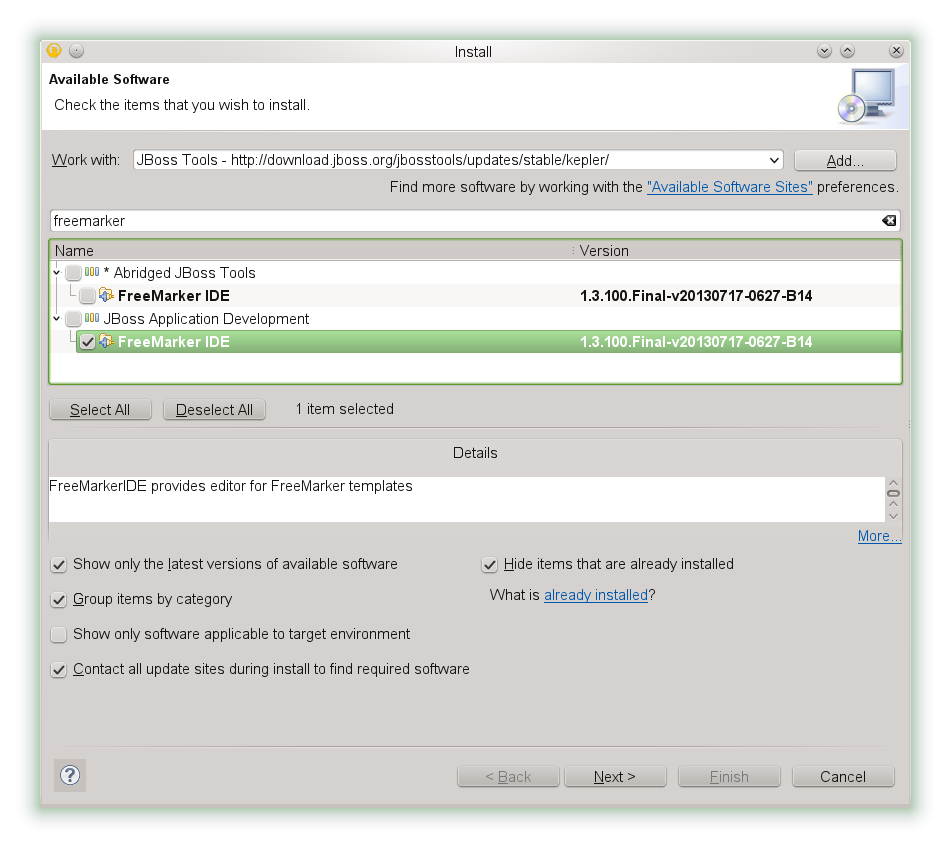
4. Basic example
Create a new Java project chosen com.vogella.freemarker.showtime. Create a new folder chosen lib and add the Freemarker library to it. Add this library to the classpath for your project.
If you don't know how to accomplish that, please run into the Eclipse IDE Tutorial for instructions on the required steps.
Create a new folder chosen templates within the binder of the com.vogella.freemarker.commencement package. Inside that, create the following file with name helloworld.ftl.
<html> <head> <title>${title} </head> <body> <h1>${title}</h1> <p>${exampleObject.proper name} by ${exampleObject.developer}</p> <ul> <#list systems equally system> <li>${system_index + 1}. ${organisation.proper name} from ${system.programmer}</li> </#list> </ul> </torso> </html> Create the following class which demonstrates the usage of Java objects in templates.
bundle com.vogella.freemarker.first ; public class ValueExampleObject { private String proper name ; private Cord developer ; public ValueExampleObject ( String name , String programmer ) { this . proper name = name ; this . developer = developer ; } public String getName () { return proper noun ; } public String getDeveloper () { render developer ; } } Create the following class which creates the input for this template and creates the output.
package com.vogella.freemarker.first ; import coffee.io.File ; import java.io.FileWriter ; import java.io.OutputStreamWriter ; import coffee.io.Writer ; import java.util.ArrayList ; import java.util.HashMap ; import java.util.List ; import java.util.Locale ; import java.util.Map ; import freemarker.template.Configuration ; import freemarker.template.Template ; import freemarker.template.TemplateExceptionHandler ; import freemarker.template.Version ; public class MainTest { public static void master ( String [] args ) throws Exception { // 1. Configure FreeMarker // // You should practise this ONLY ONCE, when your awarding starts, // and so reuse the same Configuration object elsewhere. Configuration cfg = new Configuration (); // Where do we load the templates from: cfg . setClassForTemplateLoading ( MainTest . course , "templates" ); // Some other recommended settings: cfg . setIncompatibleImprovements ( new Version ( 2 , 3 , 20 )); cfg . setDefaultEncoding ( "UTF-8" ); cfg . setLocale ( Locale . US ); cfg . setTemplateExceptionHandler ( TemplateExceptionHandler . RETHROW_HANDLER ); // 2. Proccess template(s) // // You lot will do this for several times in typical applications. // two.1. Prepare the template input: Map < String , Object > input = new HashMap < String , Object >(); input . put ( "title" , "Vogella example" ); input . put ( "exampleObject" , new ValueExampleObject ( "Java object" , "me" )); List < ValueExampleObject > systems = new ArrayList < ValueExampleObject >(); systems . add ( new ValueExampleObject ( "Android" , "Google" )); systems . add ( new ValueExampleObject ( "iOS States" , "Apple" )); systems . add ( new ValueExampleObject ( "Ubuntu" , "Approved" )); systems . add together ( new ValueExampleObject ( "Windows7" , "Microsoft" )); input . put ( "systems" , systems ); // 2.two. Get the template Template template = cfg . getTemplate ( "helloworld.ftl" ); // 2.3. Generate the output // Write output to the panel Writer consoleWriter = new OutputStreamWriter ( Arrangement . out ); template . process ( input , consoleWriter ); // For the sake of example, likewise write output into a file: Writer fileWriter = new FileWriter ( new File ( "output.html" )); endeavour { template . procedure ( input , fileWriter ); } finally { fileWriter . close (); } } } five. Useful FTL tricks
5.1. Reuse common template fragments
When you find yourself copy-pasting mutual parts betwixt templates a lot, you should probably use macros.
Continuing our terminal example, create a new binder called lib inside the templates directory, and there create a file chosen utils.ftl, with this content:
<#macro page> <html> <head> <title>${title} </caput> <body> <h1>${title}</h1> <#-- This processes the enclosed content: --> <#nested> </body> </html> </#macro> <#macro otherExample p1 p2> <p>The parameters were: ${p1}, ${p2}</p> </#macro> Now you can simplify helloworld.ftl like this:
<#import "lib/utils.ftl" as u> <@u.page> <p>${exampleObject.name} by ${exampleObject.developer}</p> <ul> <#listing systems as system> <li>${system_index + 1}. ${system.proper noun} from ${system.developer}</li> </#list> </ul> <#-- Just some other example of using a macro: --> <@u.otherExample p1=11 p2=22 /> </@u.folio> Another manner of reusing template fragments is moving the mutual fragment into its own ftl file. Then just insert it with <#include "lib/myfragment.ftl">. This is less flexible than macros, but simpler in concept: it mimics copy-pasting.
5.2. Variables
You tin can define and assign content to variables inside the FTL files for easy reuse.
<#assign var_link = "https://www.vogella.com/people/larsvogel.html"> <a href="${var_link}">About Lars Vogel</a> 5.3. If then else
` You can handle if / else cases, see below for an example.
<#assign name = "${article.getName()}"> <#if name?starts_with("https")> <a href="http://www.larn.com</a> <#else> <a href="http://www.vogella.com/tutorials/${name}/article.html">${championship}</a> </#if> v.4. Treatment null/undefined values
FreeMarker requires you to provide an explicit default for variables, so avoid values that are nada or undefined:
<!-- Acts like if the color was N/A if there'south no color: --> <p>Color: ${color!'Due north/A'}</p> <!-- Avoid the whole color row if in that location's no color: --> <#if colour??> <p>Color: ${color}</p> </#if> 5.5. Escape
When generating HTML, information technology'due south important to escape <, &, etc. in values that were not meant to store HTML and tin can incorporate these problematic characters. You lot can apply such escaping like ${message?html}. You can also ask FreeMarker to add ?html to all ${} -s in a section similar this:
<#escape 10 as x?html> <p>Sender: ${from} <p>Title: ${title} <p>Message: ${body} </#escape> It's important to understand that #escape just affects the ${} bits that are inside the enclosed section in the template file when you look at it in a text editor. That means, ${} embracements which are in other templates or macros called from at that place, won't exist afflicted.

Is Freemarker Template Strict Xml,
Source: https://www.vogella.com/tutorials/FreeMarker/article.html
Posted by: woodfordgaird1974.blogspot.com
0 Response to "Is Freemarker Template Strict Xml"
Post a Comment